How to Use Sora 2 for Free: A 2026 Practical Playbook

Free Sora Generator Teamon 2 hours ago

How to Use Sora 2 for Free: A 2026 Practical Playbook

How to Use Sora 2 for Free Cover

Using Sora 2 for free is possible, but only if you treat free credits like a production budget. Many creators burn through free quota in one night because they generate randomly, change ten things at once, and never measure what improved. This guide gives you a repeatable system to get consistent results without wasting credits.

I am not going to sell you a fantasy of “infinite free AI video.” Instead, I will show you how people who actually ship videos use free quota efficiently: define the scene before generation, test prompts in controlled iterations, keep evidence logs, and only spend credits where it creates clear output value.

If your goal is to produce publishable videos for content, social, websites, and lightweight ads while keeping costs near zero, this is the workflow.


1) Why you should trust this method

Most tutorials about Sora 2 are built for views, not for production. They often show one lucky output, then skip the process that produced it. The problem with that style is obvious: you cannot replicate luck on deadline.

This playbook is built for repeatability under constraint. It is based on four principles:

  1. Process beats inspiration: Creative ideas matter, but process is what turns ideas into usable outputs.
  2. Measured iteration beats random retries: If you cannot explain what changed between V1 and V2, you are gambling with credits.
  3. Use-case constraints must be explicit: A good-looking clip is not automatically usable for a landing page, ad, or social feed.
  4. Credit efficiency is a skill: Free access is enough for many creators when the workflow is disciplined.

In practice, people who follow these principles usually produce more usable assets with fewer generations. The gap is not talent; the gap is workflow quality.

Who this guide is for

  • Solo creators building short-form content
  • Indie founders needing hero videos and social assets
  • Growth teams running small-budget tests
  • New users trying Sora 2 without immediate paid plans

What this guide is not

  • Not a one-click shortcut
  • Not a “secret free exploit”
  • Not model hype without execution detail

This is a practical operating system for using Sora 2 free quota with intent.

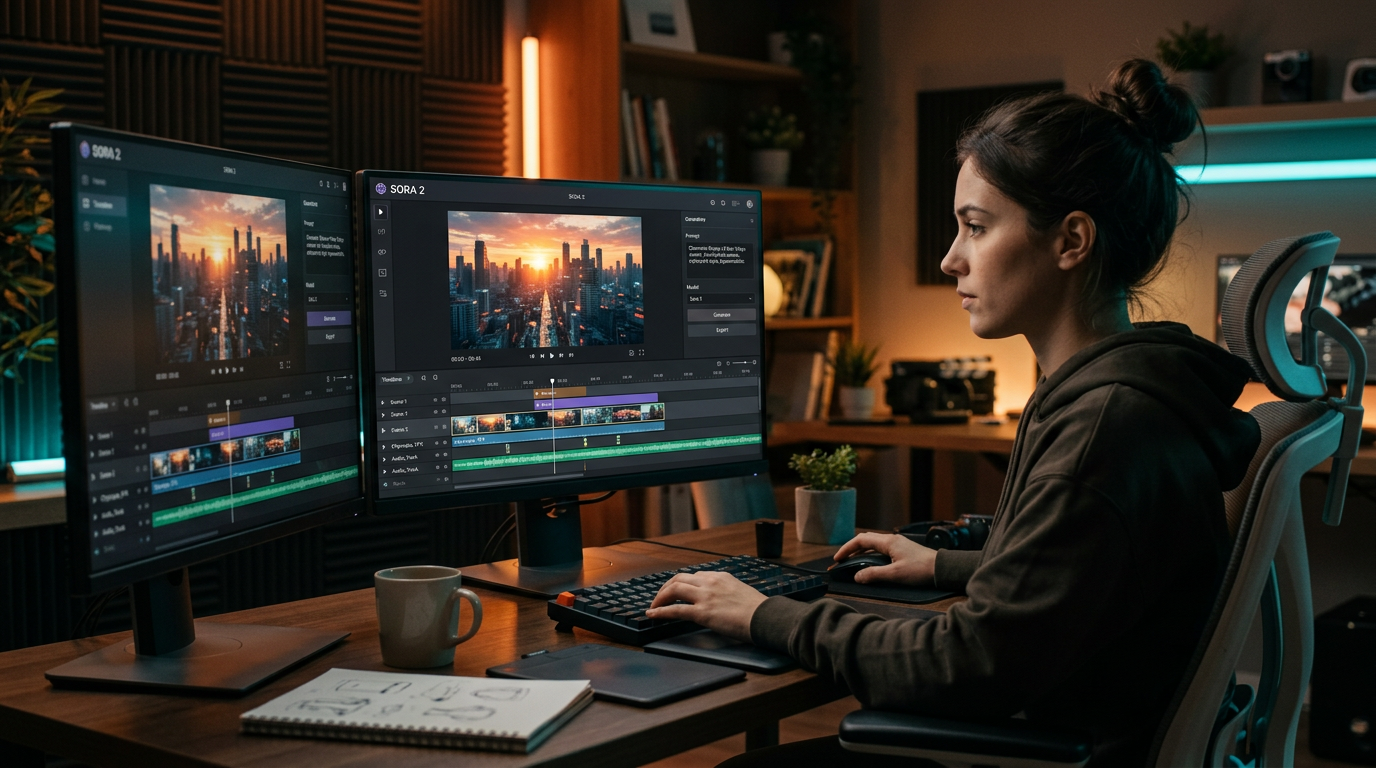
Creator credibility / testing desk


2) How to evaluate your Sora 2 output

Before generating anything, define how you will score success. Without a scoring model, your brain defaults to “this looks cool,” which is a poor standard for production.

Use this 5-factor scorecard for every output:

A. Prompt fidelity (0-5)

Does the output actually match what you asked for?

  • Correct subject
  • Correct environment
  • Correct mood and pacing
  • Correct camera behavior

B. Temporal consistency (0-5)

Does it stay coherent over time?

  • Character and object stability
  • Motion continuity
  • No obvious drifting artifacts

C. Editability (0-5)

Can you improve it quickly?

  • Small prompt changes lead to predictable output differences
  • You can isolate one variable per iteration

D. Use-case readiness (0-5)

Can this clip be used in your real context?

  • 16:9 framing if needed
  • Center-safe area for text overlays
  • No distracting foreground chaos

E. Credit efficiency (0-5)

Did you spend quota wisely?

  • Number of attempts to get one usable clip
  • Time spent per usable result

Total score: 25.

A practical threshold:

  • 20+: usable for publish pipeline
  • 16-19: usable with editing or selective cuts
  • <=15: rework prompt strategy

Why this matters on free tier

When credits are limited, quality per generation is the game. You are not optimizing for perfect art. You are optimizing for usable output ratio.

Evaluation framework board


3) Real test evidence (most important)

Let’s walk through a real scenario with controlled changes.

Test scenario

Goal: produce a 20-second 16:9 website hero loop for a SaaS homepage about AI automation.

Target constraints:

  • Modern city + subtle futuristic vibe
  • Slow and calm camera movement
  • Clean center composition for headline text
  • Loop-friendly ending

V1 prompt (broad)

A futuristic city at sunrise, cinematic, beautiful, AI world.

Observed output:

  • Nice style, weak control
  • Camera movement inconsistent
  • Busy center region blocks headline area
  • Not loop-ready

Score:

  • Fidelity: 2
  • Consistency: 3
  • Editability: 2
  • Use-case readiness: 1
  • Credit efficiency: 2
  • Total: 10/25

V2 prompt (structured)

Wide 24mm establishing shot of a clean futuristic city at sunrise. Camera slowly pushes forward over 6 seconds. Blue and warm gold color palette. Keep skyline stable. Avoid crowd clutter.

Observed output:

  • Better camera behavior
  • Better visual hierarchy
  • Still imperfect center-safe composition

Score:

  • Fidelity: 4
  • Consistency: 4
  • Editability: 4
  • Use-case readiness: 3
  • Credit efficiency: 4
  • Total: 19/25

V3 prompt (delivery constraints added)

16:9 clip for website hero background. Keep center area visually clean for text. Slow forward motion, no abrupt foreground crossing, loop-friendly final frame with stable skyline silhouette.

Observed output:

  • Strong alignment with actual deployment need
  • Minimal post-fix required
  • Best clip reached with fewer additional retries

Score:

  • Fidelity: 5
  • Consistency: 4
  • Editability: 5
  • Use-case readiness: 5
  • Credit efficiency: 5
  • Total: 24/25

What this evidence proves

  1. “Poetic” prompts are expensive.
  2. Camera instructions are mandatory.
  3. Delivery constraints are where free-tier efficiency comes from.
  4. Controlled iteration (V1→V2→V3) is the fastest path to usable output.

Evidence logging template (copy this)

For each test run, record:

  • Prompt version
  • Changed variable
  • Score delta
  • Failure mode
  • Next action

This one habit can cut wasted free generations by a large margin.

Real test evidence board


4) Tool-by-tool intro (fixed framework)

Sora 2 is the core, but not the entire pipeline. If you want free-tier sustainability, each tool must have a clear role.

Use this fixed framework for every tool:

  1. Best use-case
  2. Strengths
  3. Failure modes
  4. Best stage in workflow
  5. KPI impact

Tool A: Sora 2 (core generation)

Best use-case:

  • Scene generation
  • Visual concepting
  • Hero-level shots

Strengths:

  • Strong visual imagination
  • Atmosphere quality
  • Fast idea-to-first-shot

Failure modes:

  • Output variability without constraints
  • Continuity drift in multi-shot sequence

Best stage:

  • Concept and primary asset generation

KPI impact:

  • Output quality and creative range

Tool B: Prompt planner (Notion / docs template)

Best use-case:

  • Structure before generation

Strengths:

  • Reduces random retries
  • Improves team alignment

Failure modes:

  • Slight upfront time cost

Best stage:

  • Pre-generation

KPI impact:

  • Credit efficiency and predictability

Tool C: Video editor (CapCut / DaVinci / Premiere)

Best use-case:

  • Final polish
  • Captions/transitions/sound timing

Strengths:

  • Production-grade output control

Failure modes:

  • Time-consuming if source clips are weak

Best stage:

  • Post-generation

KPI impact:

  • Publishability and retention quality

Tool D: QA checklist sheet

Best use-case:

  • Batch quality gating

Strengths:

  • Prevents low-quality publishing
  • Creates reusable team standards

Failure modes:

  • Requires discipline

Best stage:

  • Pre-publish

KPI impact:

  • Quality consistency and reduced rework

Tool stack in one workflow

Why this fixed framework works

When every tool has a defined job, you avoid the two biggest free-tier killers:

  • tool hopping
  • over-generation without output discipline

5) Decision framework (how to choose the right path)

Do not ask “What is the best prompt?” Ask: “What workflow matches my goal, budget, and timeline?”

Step 1: Pick your primary goal

  • Brand storytelling
  • Ad creative testing
  • Website visuals
  • Daily social publishing

Step 2: Pick your tradeoff

You can maximize two, not three:

  • Speed
  • Quality
  • Cost

Step 3: Select one workflow mode

Mode A: Free-first speed mode

Best for daily social posting.

  • One prompt template
  • 3 generations max
  • Pick one winner
  • Light edit and publish

Mode B: Free-first performance mode

Best for growth tests.

  • One concept, 5 variants
  • Score with 5-factor model
  • Select top 2 for A/B

Mode C: Hybrid premium mode

Best when quality requirement is high.

  • Use free passes for concept exploration
  • Spend paid quota only on finalist prompts
  • Push final polish in editor

Step 4: Add stop-loss rules

  • Max retries per shot: 5
  • Max time per concept: 45 minutes
  • If score doesn’t improve after two iterations, pivot concept

Step 5: Build a reusable prompt library

Store:

  • Winning prompts
  • Failed patterns
  • Reusable style blocks
  • Deployment-specific constraints

This turns free usage from random output into a growing production asset.

Decision flowchart for free vs paid


6) FAQ (long-tail SEO focus)

Q1: Can I use Sora 2 for free long term?

Yes, if your workflow is efficient and your goals match free-tier limits.

Q2: What is the fastest way to reduce wasted free credits?

Structured prompts + one-variable iterations + score logging.

Q3: Is Sora 2 free enough for YouTube Shorts or Reels?

For lightweight content pipelines, yes. For high-volume campaigns, hybrid free+paid is better.

Q4: How many retries should I allow per clip?

Usually 3-5. Beyond that, revise the concept, not just wording.

Q5: What prompt structure works best for Sora 2?

Subject + environment + camera motion + style + delivery constraint.

Q6: Why does my output look good but fail in production?

Because prompt lacked usage constraints like text-safe center, aspect ratio, and loop behavior.

Q7: Should beginners buy paid plans immediately?

Not necessary. Learn process discipline first on free quota.

Q8: How do I keep visual consistency across multiple clips?

Lock recurring camera style, color palette, mood, and movement language.

Q9: What is the best free workflow for landing page hero videos?

Use 16:9 prompt constraints, center-safe composition, subtle loop-friendly motion.

Q10: How do I decide when to upgrade to paid?

Upgrade when free quota blocks business throughput, not when random output frustrates you.


Final takeaway

Sora 2 free usage is not about luck. It is about control.

If you adopt the six-module framework in this article, you can get high-quality, publishable video assets while keeping generation cost extremely low. The most important shift is mindset: from “generate more” to “generate with intent.”